Our Location
No. 2177, Shunhe Road,
Zhucheng City, Shandong Province, China

No. 2177, Shunhe Road,
Zhucheng City, Shandong Province, China

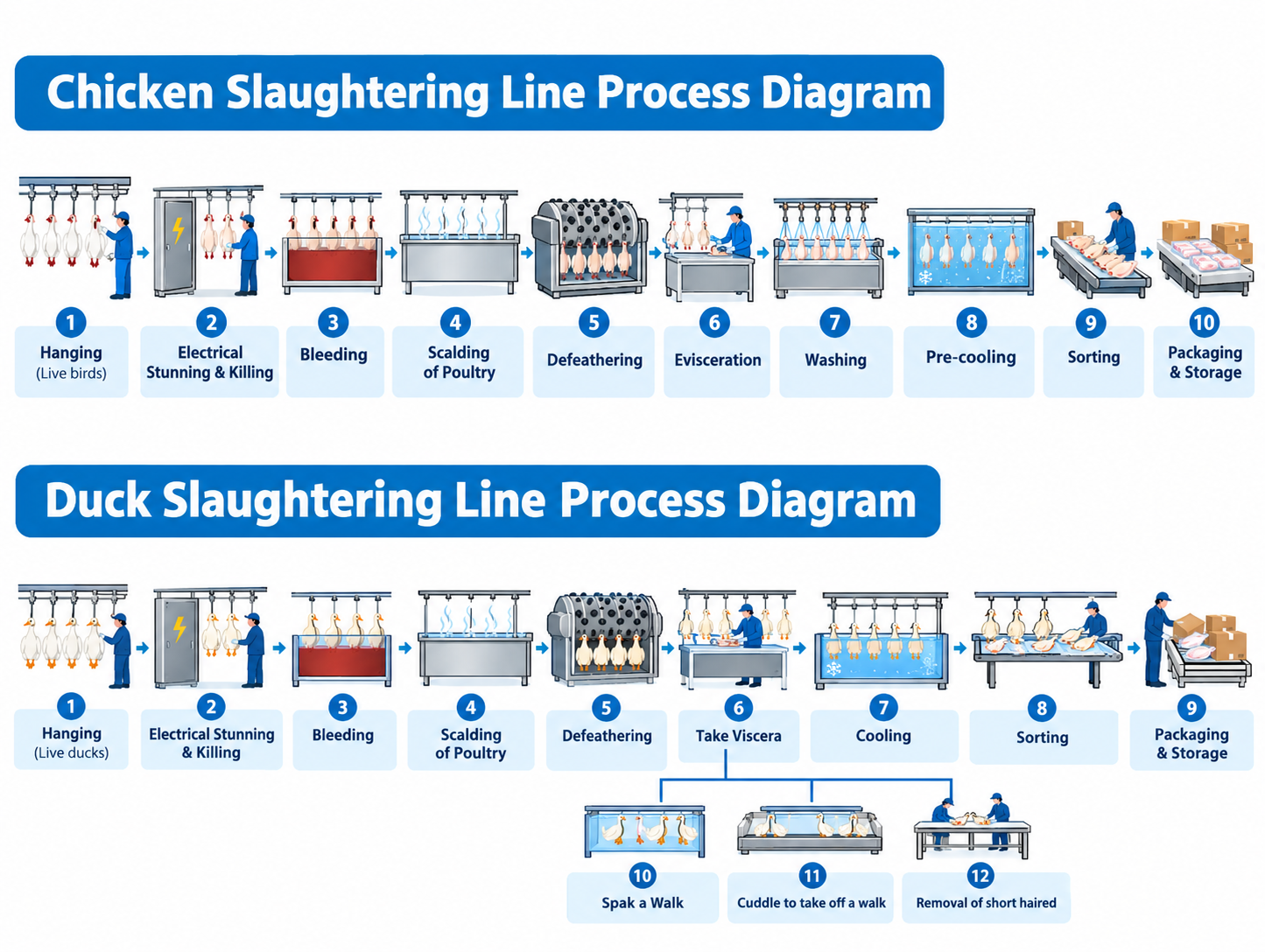
Broiler chicken production and poultry slaughtering are closely connected. Proper bird handling before slaughter, a well-designed slaughtering process, hygienic processing areas, controlled scalding and defeathering, efficient evisceration, rapid chilling, grading, packaging and freezing all contribute to final poultry meat quality.
This guide summarizes the main production methods, live-bird handling practices, broiler slaughtering process, hygiene requirements, major processing operations, refrigeration requirements, by-products and wastewater considerations.
Technical reference: The numerical values in this article are translated and organized from the supplied technical reference material. Some of the cited standards and practices are historical references. Actual slaughterhouse design, food-safety requirements, animal-welfare requirements and wastewater-discharge limits should be confirmed against the regulations applicable in the target country.
Commercial broiler production generally uses two major housing systems: floor rearing with deep litter and multi-tier cage housing. Floor rearing is widely used because its initial investment is relatively low and early-stage temperature control is convenient. It can also help reduce the incidence of leg disorders and breast blisters.
Traditional manual catching of broilers can be labor-intensive and may increase bird stress and handling damage. Modern poultry operations increasingly use mechanical catching equipment, including vehicle-mounted poultry catching machines, conveyor-type systems and containerized poultry handling equipment.
The major advantage of cage housing is the efficient use of available housing space and the ability to achieve a higher stocking density. Modern cage designs and improvements in broiler genetics have also helped control or reduce breast blister problems.
Whether broilers are raised on litter or in cages, separating male and female birds can help maintain more consistent body weight and body shape. This can improve flock management and support more consistent slaughtering and processing performance.
Broilers should preferably be caught at night. Lower activity and reduced visibility can help minimize struggling, collisions, bruising and fractures.
Feed withdrawal before slaughter is generally recommended for approximately 8–12 hours. During feed withdrawal, live-weight loss is mainly caused by excretion. Prolonged feed withdrawal can lead to additional tissue weight loss and watery intestinal contents, which can negatively affect slaughtering operations.
Live poultry should be transported smoothly and without unnecessary vibration or impact. The number of birds placed in transport crates should be adjusted according to weather conditions. Fewer birds should be loaded during hot weather, while somewhat higher loading density may be used during cold weather when appropriate.
A traditional catching team may include approximately 8–9 people:
Bruising cannot always be completely avoided during catching and transportation. The reference material indicates that a bruising rate of approximately 8–12% was considered within the normal range in the practices described.
Different markets may require slightly different poultry processing systems. A conventional whole-bird broiler processing line generally follows this sequence:
Live bird hanging → Electrical stunning → Slaughtering → Bleeding → Scalding → Defeathering → Carcass washing → Head and trachea removal → Feet cutting → Rehanging → Evisceration → Giblet removal → Carcass washing → Chilling → Weighing and grading → Packaging → Freezing → Frozen storage
Edible giblets such as the heart, liver and gizzard can be cleaned, washed, chilled and packed. Depending on the product specification, they may be placed inside the whole chicken cavity or packed separately.
From live-bird receiving through frozen storage, the slaughterhouse process can be divided into four major operational zones:
These zones should be clearly separated in the plant layout to reduce cross-contamination.
Modern poultry processing plants can use separate overhead conveyor circuits for different production areas. The reference material notes that at least three conveyor systems should be used when applying the relevant European-style hygiene separation principles.
Because evisceration is generally slower and more labor-intensive than hanging, slaughtering and defeathering, production-line design may use separate conveyor circuits to balance processing speeds. Birds can be transferred between conveyor systems manually or with mechanical transfer equipment.
Poultry slaughterhouses must be designed around food hygiene, personnel hygiene and controlled product flow. This is particularly important for facilities producing poultry meat for export.
The slaughterhouse site should meet the following general requirements:
Processing rooms should use moisture-resistant and non-toxic doors and windows. Insect-control measures should be provided where necessary.
Walls in processing areas should use washable and corrosion-resistant finishes. The reference material recommends wall protection to a height of at least approximately 2 m.
Processing floors should be made of durable, slip-resistant materials.
Processing rooms should have sufficient lighting and appropriate temperature control.
The reference material indicates approximately:
Actual room temperatures should be determined according to the applicable food-safety requirements and the specific production process.
Plant entrances and processing-room entrances should have suitable disinfection facilities.
Handwashing stations should provide the necessary combination of cold water, hot water and cleaning solution. Foot-operated or automatic controls are recommended to reduce hand contact with fixtures.
Toilets should be flush-operated, and shower facilities should be provided for workers according to the size of the workforce.
The complete slaughtering process should maintain a clear separation between hygienic and non-hygienic areas.
Key principles include:
For poultry equipment, 304 stainless steel is commonly selected for product-contact components because it provides good corrosion resistance and is suitable for food-processing environments when properly fabricated and maintained.
Modern poultry slaughterhouses normally locate the lairage area next to the live-bird hanging area. In some facilities, the two areas are combined.
The lairage area should provide suitable ventilation and temperature control. During summer, direct sunlight should be avoided. During winter, birds should be protected from strong cold drafts.
The reference material recommends keeping relative humidity in the holding area below approximately 70%.
When transportation and slaughter schedules are well coordinated, birds can remain in their transport crates until they are transferred to the hanging platform. This can reduce the need for additional catching and handling.
The reference material lists several typical transport-crate dimensions, including approximately:
Typical capacity depends on crate design and bird size. One listed containerized system measures approximately 142 × 119 × 127 cm and has four tiers with a capacity of approximately 240 broilers.
Birds can be transferred to the hanging platform manually, by conveyor or using a forklift/container-handling system.
When hanging broilers, adequate clearance should be maintained between the bird hooks and transport crates to reduce the risk of head impacts and facilitate operator handling.
The reference productivity for manual hanging is approximately 15–18 birds per minute per worker.
Electrical stunning followed by slaughter is widely used in modern poultry processing. The main objectives are to help control bird movement, facilitate slaughtering operations and support effective bleeding.
The reference material notes that stunning practices can vary according to market requirements. Some markets may have specific preferences concerning whether electrical stunning is used, so the process should be designed according to the destination market and applicable religious, animal-welfare and food-safety requirements.
For halal poultry processing, the stunning and slaughtering method must be designed according to the requirements of the relevant halal authority and the customer’s certification requirements.
The supplied reference material describes broiler stunning current and time parameters, including:
The time from hanging to stunning should allow the birds to settle before entering the stunning system. The reference material indicates approximately 40–60 seconds.
The interval between stunning and slaughter is described as approximately 14–37 seconds, with approximately 17–21 seconds commonly cited for broilers.
These electrical parameters are historical reference values from the supplied material and should not be treated as universal operating settings. Actual stunning parameters must be validated for the specific equipment, bird size, electrical system, welfare requirements and applicable regulations.
Mechanical slaughtering may use a rotating or circular cutting blade to open the appropriate neck blood vessels. Manual slaughtering methods vary according to the processing system and religious requirements.
The supplied reference material notes that an experienced manual slaughter operator could process a high number of birds per hour under suitable working conditions.
Bleeding time is an important part of poultry slaughtering because effective bleeding improves carcass appearance and can reduce undesirable dark-bone effects.
The reference material gives a bleeding period of approximately 55–133 seconds, with longer bleeding times potentially required in colder weather.
Only part of the total blood volume is removed during slaughter, with most blood flow occurring during the first several tens of seconds.
A dedicated blood collection trough or blood collection tank should be considered in the slaughterhouse design.
Collecting blood separately can:
Blood is one of the major contributors to the organic pollution load of poultry-processing wastewater.
Scalding temperature and time directly affect defeathering performance and carcass quality. The appropriate scalding process depends on:
Scalding can generally be categorized as high-temperature, medium-temperature or low-temperature scalding.
The reference material gives the following historical temperature/time ranges:
| Scalding method | Temperature | Time |
|---|---|---|
| High temperature | 71.1–82.8°C | 30–60 s |
| Medium temperature | 58.9–60.0°C | 30–70 s |
| Low temperature | 50.6–54.8°C | 90–120 s |
Broilers are commonly processed using lower-temperature scalding when the product specification requires suitable skin quality.
Whether birds are scalded while hanging or after being removed from the conveyor, the scalding tank should have automatic temperature control.
Stable water temperature is important for consistent feather removal.
Modern scalding systems may achieve high temperature-control accuracy. The reference material also notes that steam scalding has been widely used in some European poultry-processing plants because it can provide hygienic benefits and improve scalding performance, although water and energy requirements must be considered.
Commercial poultry defeathering machines are generally available in vertical and horizontal configurations.
Two or three defeathering machines may be arranged in sequence to improve feather-removal performance.
The exact number of machines depends on bird size, line capacity, scalding method and required feather-removal quality.
Carcasses should be washed during and after defeathering to remove loose feathers and contamination.
The supplied reference material cites a carcass cleaning rate of more than 95% under suitable conditions.
Hot-water washing can significantly reduce the microbial load on the carcass surface, but water temperature and sanitation procedures must comply with the applicable food-safety requirements.
Evisceration can be performed manually or mechanically.
Many poultry processing plants use manual evisceration, particularly at smaller production capacities or where flexible product handling is required.
The reference material gives the following historical processing targets:
During inspection, edible and non-edible viscera must be handled according to the applicable veterinary inspection and food-safety procedures.
The heart, liver and gizzard can be separately collected, cleaned, washed and chilled. Depending on the product specification, they can be packed separately or placed inside the whole chicken cavity.
After evisceration and washing, poultry carcasses should be chilled rapidly.
The supplied reference material recommends reducing cleaned carcass and edible giblet temperatures to approximately 4°C within a short period.
Chilling has a direct influence on poultry meat quality and shelf life.
Two major poultry chilling methods are:
Water chilling can be suitable for frozen poultry products and can help reduce surface discoloration. Air chilling is commonly associated with fresh-chilled poultry products.
A two-stage water-chilling system can be used:
The reference material cites a water-chilling time of approximately:
The chilling tank should have suitable overflow and water-management facilities.
The reference material indicates that more than approximately 1.9 liters of cooling water per bird may be required under the cited conditions.
During water chilling, the temperature difference between the carcass and chilling water can cause water absorption.
The reference material cites:
Actual allowable water uptake depends on current regulations in the target market and should be verified before commercial production.
After chilling, carcasses can be weighed and sorted manually or automatically.
Automatic poultry grading systems can classify birds according to weight. Additional quality grading can consider:
For whole-bird products, chilled edible giblets can be inserted into the carcass cavity before final packaging.
Carcasses with certain defects or products intended for further processing can be cut into:
Cut-up poultry and boneless chicken products have become important categories in many markets.
Because cutting and packaging can involve a significant amount of manual labor, sufficient working space should be allocated for the grading, cutting and packaging areas.
Each whole chicken can be packed in a food-grade plastic bag. Vacuum packaging is an option when longer shelf life, product presentation or reduced package volume is required.
Two general carton-packaging methods are described in the reference material:
The bagged chicken is first placed on a metal tray, frozen, removed from the tray and then packed into cartons before frozen storage.
Advantages include:
The packaged chicken is placed directly into cartons before freezing. The cartons then enter the freezing room and are transferred directly to frozen storage after freezing.
Advantages include:
Microbial activity and poultry meat quality are affected by freezing time, freezing temperature and the initial microbial condition of the product.
For long-term frozen storage, rapid freezing is preferred.
The supplied reference material describes advanced freezing conditions in which the internal temperature of poultry meat can be reduced below approximately −30°C within 4–6 hours, with a freezing-room environment around −40°C.
The freezing point of poultry meat is approximately −1 to −1.7°C.
Rapid freezing means passing the product through this temperature range quickly and continuing the temperature reduction.
The reference material describes a target of approximately −18°C internal temperature within 6 hours for rapid freezing.
Rapid freezing can help limit structural damage and dehydration and preserve poultry meat quality.
Frozen poultry can subsequently be stored in a frozen-storage room at approximately −25°C or another temperature required by the applicable product-storage specification.
The reference material also lists traditional reference conditions of approximately:
The supplied reference material gives the following historical reference storage densities:
| Product | Reference storage density |
|---|---|
| Bulk frozen poultry | approximately 400 kg/m³ |
| Cartoned frozen poultry | approximately 350 kg/m³ |
Actual cold-room capacity should be calculated according to packaging dimensions, stacking height, airflow, product temperature, refrigeration load and local design standards.
Major poultry slaughtering by-products include:
For a plant processing approximately 24,000 broilers per day, with a live weight of approximately 1.5 kg per bird, the reference material estimates daily production of approximately:
Proper utilization of poultry by-products can reduce environmental pollution and create additional commercial value.
Potential products include:
A suitable by-product handling system should be integrated into the poultry processing plant design.
Poultry slaughterhouses are relatively high water users and wastewater generators.
Wastewater can come from:
Poultry-processing wastewater may contain:
Blood is one of the most important pollution sources in a poultry slaughterhouse because of its high organic load.
The reference material cites a BOD value for blood of approximately 92 g/L and notes that recovering a significant proportion of blood can substantially reduce the organic load entering the wastewater-treatment system.
If approximately 70% of blood is recovered, the reference material estimates that the wastewater pollution load could be reduced by approximately 35–40%.
Therefore, a dedicated blood collection system is an important component of a modern poultry slaughterhouse.
Water consumption depends on:
The reference material gives historical examples of water consumption of approximately:
These figures should be treated as historical reference values rather than universal design standards.
Water-saving systems can recycle suitable overflow water between compatible operations. For example, the reference material describes using suitable overflow water from the chilling tank to supplement scalding-tank water and using suitable scalding overflow water for feather transport.
Such water-reuse systems must be designed carefully to avoid cross-contamination and must comply with current food-safety regulations.
A well-designed poultry processing facility should maintain a logical product flow from live birds to finished packaged products.
A typical process layout is:
Live Bird Receiving
→ Lairage
→ Bird Hanging
→ Stunning
→ Halal/Manual or Mechanical Slaughter
→ Blood Collection
→ Bleeding
→ Scalding
→ Defeathering
→ Carcass Washing
→ Head/Trachea Removal
→ Feet Cutting
→ Rehanging
→ Evisceration
→ Giblet Processing
→ Final Carcass Washing
→ Pre-Chilling / Chilling
→ Drip Line
→ Weighing and Grading
→ Whole Chicken or Cut-Up Processing
→ Vacuum Packaging / Bag Packaging
→ Carton Packing
→ Blast Freezing
→ Frozen Storage
The exact equipment list depends on the required production capacity, bird weight, product type, slaughter method, chilling method and degree of automation.
When planning a commercial poultry slaughtering line, the following factors should be confirmed before equipment selection:
Specify the target capacity in birds per hour (BPH), such as:
Bird weight affects:
The project should specify whether it requires:
The final system should follow the destination country’s regulations and the customer’s certification requirements.
Common product formats include:
The customer should decide between:
The required refrigeration capacity depends on daily production, storage days, product temperature, freezing time and desired frozen-storage temperature.
A poultry slaughterhouse should include an appropriate wastewater-treatment solution based on:
Blood, feathers, heads, feet, viscera and bones should be considered during the plant design stage. Dedicated collection systems can improve hygiene and reduce wastewater pollution.
A successful broiler slaughtering and processing plant is more than a collection of individual machines. The complete system must coordinate live-bird handling, stunning and slaughtering, bleeding, scalding, defeathering, evisceration, chilling, grading, packaging, freezing, by-product handling and wastewater treatment.
Good plant design should maintain a clear separation between live-bird, contaminated, semi-clean and clean areas. Food-contact equipment should use suitable hygienic materials, and the process should minimize cross-contamination and unnecessary product handling.
For commercial poultry processing projects, equipment capacity and plant layout should be designed according to the customer’s actual production target, bird weight, slaughter method, final products, local utilities and regulatory requirements.
A properly integrated poultry slaughtering line can improve processing consistency, product hygiene, labor efficiency and overall production management while providing a practical foundation for future capacity expansion.
Live Bird Receiving → Hanging → Stunning → Slaughter → Blood Collection → Bleeding → Scalding → Defeathering → Washing → Head/Feet Processing → Evisceration → Giblet Processing → Final Washing → Chilling → Dripping → Weighing → Grading → Packaging → Freezing → Frozen Storage
For a modern commercial poultry processing plant, every stage should be considered as part of one integrated production system rather than as an isolated machine.


